

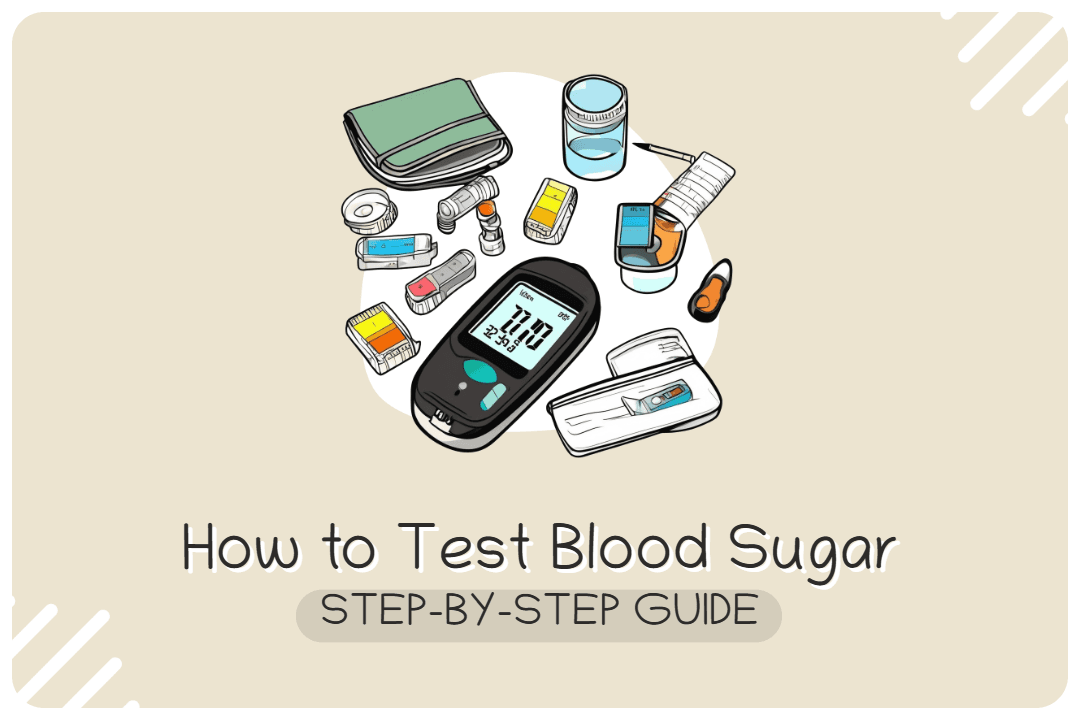
You just got your gestational diabetes diagnosis. Your provider handed you a glucose meter and said, "Test your blood sugar 4 times a day."
And you're thinking: Wait... how exactly do I do this?
Don't worry—testing blood sugar is actually pretty simple once you know the steps. But there are a few tricks to make it easier, less painful, and more accurate.
In this guide, we'll cover:
Step-by-step testing instructions
Best testing sites (spoiler: your fingertip isn't the only option!)
What to do if blood won't come out
How to avoid sore fingers
How to log your results
Common testing questions
Let's get you testing like a pro!
Before you start, gather these supplies:
Glucose meter (your provider should have given you one)
Test strips (specific to your meter)
Lancet (the tiny needle that pricks your finger)
Lancing device (holds the lancet)
Alcohol wipes or hand soap (to clean your finger)
Tissue or cotton ball (to stop bleeding)
Logbook or app (to record your results)
This is the most important step!
Wash your hands with warm soap and water
Dry completely with a clean towel
Warm water helps blood flow to your fingertips
Why this matters:
Dirt, food residue, or glucose on your fingers can give false readings
Cold hands make it harder to get blood
Alcohol wipes work but aren't as effective as soap and water
Turn on your meter
Insert a fresh test strip
Wait for the meter to be ready (usually a beep or symbol)
Pro tip: Check the expiration date on your test strips. Expired strips can give inaccurate readings.
Load a fresh lancet into the lancing device
Set the depth to a comfortable level (usually 2-3 for adults)
Don't reuse lancets—they get dull and hurt more
Note on depth:
Too shallow = not enough blood
Too deep = more pain and scarring
Start at 2 and adjust if needed
Your fingertip is NOT your only option!
Best testing sites (in order of preference):
Side of your fingertip (most accurate)
Use the sides of your pinky, ring, or middle finger
Avoid your index finger and thumb (you use them most!)
Rotate which finger you use each time
Less sensitive than the pad of your finger
Palm side of your forearm (less painful, but check with your provider first)
Less sensitive than fingertips
Great if your fingers are sore
Important: Forearm readings may lag behind fingertip readings by 20-30 minutes
Check if your meter is approved for alternate site testing
Ask your provider if alternate site testing is okay for you—many prefer fingertip testing for post-meal readings
Upper arm (if your meter allows)
Check if your meter is approved for alternate site testing
Less painful option
Same cautions as forearm testing
Important note about alternate site testing:
Forearm and upper arm readings may not be as accurate during times of rapid blood sugar change (like after eating)
Since gestational diabetes testing focuses on post-meal readings, fingertip testing is usually preferred
Ask your provider before using alternate sites
Rotate your testing sites to avoid building up scar tissue and calluses.
Hold the lancing device against your chosen site
Press the button to prick
Don't squeeze your finger yet!
Pro tips:
Prick quickly and confidently (hesitating makes it worse!)
Prick on the side of your fingertip, not the center
If you're nervous, take a deep breath first
Now gently squeeze your finger to get a drop of blood.
Squeeze from the base of your finger toward the tip
You need enough blood to fill the test strip (usually a small drop)
Don't squeeze too hard—you'll dilute the blood with tissue fluid
If blood won't come out: See the troubleshooting section below!
Touch the drop of blood to the test strip opening (not the meter itself)
Let the blood fill the strip naturally—don't smear it
The meter will beep when it has enough blood
Pro tip: Some meters let you apply blood from the side of the strip, which is easier than the top.
The meter will beep and display your blood sugar number
This usually takes 5-10 seconds
Write down your result immediately (or log it in your app)
Press a tissue or cotton ball to your finger
Hold for 10-15 seconds
The bleeding will stop quickly
Your provider will tell you the specific testing schedule, but here's the typical pattern:
Standard testing schedule:
Fasting: First thing in the morning, before eating or drinking anything
1 hour after breakfast: Exactly 1 hour after your first bite
1 hour after lunch: Exactly 1 hour after your first bite
1 hour after dinner: Exactly 1 hour after your first bite
Some providers also ask for:
2-hour readings (instead of 1-hour)
Bedtime readings
Middle-of-the-night readings
Always follow your provider's specific instructions.
Check with your provider about timing.
Most providers ask you to test 1 hour or 2 hours from when you start eating, but some prefer 1 hour or 2 hours from when you finish eating. Ask your provider which method they want you to use.
Example (if timing from start of meal):
If you start eating breakfast at 7:00 AM, test at 8:00 AM or 9:00 AM (depending on whether your provider wants 1 or 2 hours after the start of your meal)
Not 1 or 2 hours from when you finished eating
Example (if timing from end of meal):
If you finish eating breakfast at 7:15 AM, test at 8:15 AM or 9:15 AM (depending on whether your provider wants 1 or 2 hours after the end of your meal)
Try these solutions:
Warm your hands first
Run warm water over your hands for 30 seconds
Warm hands = better blood flow
This is the #1 fix!
Prick deeper
Increase the depth setting on your lancing device
Start at 3 or 4 instead of 2
You can always adjust down if it's too deep
Prick on the side of your fingertip
The sides have more blood flow than the center
Avoid the very tip
Massage your finger
Gently massage from the base toward the tip
This encourages blood flow
Hang your arm down
Let gravity help!
Dangle your arm at your side for a few seconds before pricking
Use a different finger
Some fingers bleed more easily than others
Experiment to find your best testing sites
Don't squeeze too hard
Gentle pressure is better than aggressive squeezing
Squeezing too hard dilutes the blood
Prevention is key:
Rotate your testing sites
Use different fingers each time
Use your pinky, ring, and middle fingers (not index or thumb)
Use your forearm or upper arm if available
Use alternate site testing
If your meter allows, test on your forearm or upper arm
These areas are less sensitive and less painful
Note: Forearm readings may lag behind fingertip readings by 5-15 minutes
Use a shallower depth
If you're using depth 4 or 5, try dropping to 2 or 3
You don't need a deep prick to get blood
Let your fingers heal
If one finger is very sore, skip it for a few days
Rotate to other fingers and sites
Use a fresh lancet every time
Dull lancets hurt more and cause more trauma
Never reuse a lancet
Consider a lancing device with adjustable depth
Some devices let you adjust the depth for different sites
This gives you more control and less pain
This is normal and expected!
Most meters are accurate within ±15% of lab results
This means if your "true" blood sugar is 100, your meter might show 85-115
Different readings from the same blood sample are normal
Example: You test your finger twice in a row (same blood sample) and get:
First test: 125 mg/dL
Second test: 135 mg/dL
This is normal! The difference is within the meter's margin of error.
To understand better what your results mean and what's normal, read our Full Guide for Gestational Diabetes Numbers.
DON'T retest unless you have a good reason:
Retesting the same blood sample gives you different numbers
This can cause confusion and unnecessary worry
You'll always get slightly different results
Good reasons to retest:
Your meter gave an error message
The reading seems way off (and you have symptoms to match)
Your provider specifically asked you to retest
You made a testing error (not enough blood, contamination, etc.)
Not good reasons to retest:
You don't like the number
You want to "double-check"
You're curious what you'll get
Trust your meter. One reading is enough.
What to write down:
Date
Time of day (fasting, 1 hour after breakfast, etc.)
Blood sugar number
What you ate (optional but helpful)
Notes (how you felt, activity level, stress, etc.)
Example:
Date: Oct 18
Time: 7:00 AM (Fasting)
Reading: 92 mg/dL
Notes: Slept well, felt good
Most glucose meters come with an app that:
Automatically logs your readings
Tracks patterns over time
Lets you add notes
Shares data with your provider
Popular apps:
Your meter's official app (check the manufacturer)
Apple Health or Google Fit
General diabetes apps like MySugr or Glucose Buddy
Join the HIgedi community to:
Share your meals with blood sugar readings
Connect with other mamas managing GD
See what foods work for others
Get support and encouragement from mamas who understand
Note: HIgedi is a community platform, not a medical tracker. Use Option 1 or 2 to officially log your readings for your provider.
Download the free HIgedi app here
Bring your logbook or app to every appointment
Your provider will look for patterns, not individual readings
They'll adjust your meal plan, medication, or insulin based on trends
Ask yourself:
Which meals spike you?
Which times of day are hardest?
What foods work best for you?
Do certain activities help lower your numbers?
Example pattern: "My fasting numbers are always 100-110, but my after-meal numbers are usually 95-120. Breakfast is my hardest meal."
"Warm Water Changed Everything"
"I was struggling to get blood every time. Then someone told me to wash my hands with warm water first. Now blood comes out easily every single time. Why didn't anyone tell me this?!" – HIgedi community user
"I Rotate My Testing Sites"
"I use a different finger every time I test. My pinky, ring, and middle fingers. My fingers aren't sore anymore, and testing is so much easier!" – HIgedi community user
"I Test on the Sides of My Fingers"
"I used to prick the pad of my fingertip and it hurt SO much. Then my diabetes educator showed me to test on the sides instead. Game changer! Way less painful and I get blood every time." – HIgedi community User
"I Shake My Hand Before Testing"
"If I'm having trouble getting blood, I shake my hand vigorously for 10 seconds (like I'm shaking water off). It gets the blood flowing and makes testing easier!" – HIgedi community User
1. How often should I test my blood sugar?
Your provider will give you a schedule, but most commonly it’s: fasting, 1 or 2 hour after breakfast, lunch, and dinner. Always follow your provider’s instructions.
2. What if I get different numbers each time I test?
That’s totally normal! All glucose meters have a margin of error (usually ±15%), so small differences are expected. Don’t retest unless you have a good reason—it’ll just confuse you.
3. Can I test on my forearm or other sites?
Check if your meter allows alternate site testing and ask your provider if it’s okay for you. Forearm/upper arm testing is less painful, but may lag 5–15 minutes behind fingertip readings.
4. What do I do if my finger won’t stop bleeding?
It’s rare, but if bleeding doesn’t stop after 2–3 minutes, apply gentle pressure with a clean tissue. If it continues, call your provider. If you’re on blood thinners or have a bleeding disorder, let your provider know before testing.
5. How do I know if my glucose meter is working correctly?
Some meters come with control solution for checking accuracy. Check your manual for instructions. If you’re worried about accuracy, ask your provider or pharmacist.
6. Can I test without pricking my finger?
Not with standard glucose meters. Continuous glucose monitors (CGMs) are an option, but not all providers recommend them during pregnancy. Ask your provider if a CGM might be right for you.
7. What should I do with my used lancets?
Put used lancets in a sharps container (ask your pharmacy or use a sturdy plastic bottle with a tight lid). Never throw loose lancets in the trash.
8. Is it normal for my fingers to be sore?
Some soreness is normal, but you shouldn’t be in pain. Rotate your testing sites, use a shallower depth, and always use a fresh lancet. If soreness sticks around, talk to your provider.
9. How long do test strips last?
Check the expiration date and store strips in a cool, dry place (not the bathroom). Once opened, use within the recommended timeframe (usually 3–6 months).
10. What if I forget to test at the right time?
Test as soon as you remember and write down the actual time. Your provider will understand—life happens! Consistency matters, but one missed or late test won’t harm your baby.
11. Can stress affect my blood sugar readings?
Yes—stress can raise your actual blood sugar (thanks, cortisol), but it doesn’t affect the meter itself. If you’re stressed, your numbers might be higher.
12. Do I need to fast before testing?
Only for your fasting test (first thing in the morning). For other tests, eat normally and test 1–2 hours after your meal, as instructed.
Testing blood sugar might feel overwhelming at first, but it becomes second nature quickly. Most mamas say that after a week or two, testing is automatic—like brushing their teeth.
Remember:
Wash hands first = more accurate results
Warm hands = easier testing
Rotate your sites = less sore fingers
One reading is enough* = trust your meter
Patterns matter more than individual readings = look at the big picture
*Unless you have a specific reason to retest (like dirty hands, an error message, or a result that doesn’t match how you feel), one reading is usually enough—trust your meter!
You're doing an amazing job taking care of yourself and your baby. Every test you do is an act of love. 💙
Testing can feel isolating, but you're not alone. Thousands of mamas are testing their blood sugar right now, just like you.
The HIgedi app connects you with:
Mamas who understand what you're going through
Tips and tricks for easier testing
Support and encouragement
A community that gets it
Download the free HIgedi app and connect with other mamas
SOURCES
American College of Obstetricians and Gynecologists (ACOG) - Gestational Diabetes Practice Bulletin
Glucose meter manufacturer guidelines and accuracy standards
Real experiences from HIgedi community members
**Medical Disclaimer**
This article is for informational and educational purposes only and is not a substitute for professional medical advice, diagnosis, or treatment. Always consult your healthcare provider with questions about your gestational diabetes management, blood sugar testing, and any concerns. Every pregnancy is unique, and your provider can give you personalized recommendations based on your individual health.
Get a Free 20-Day Shopping List