

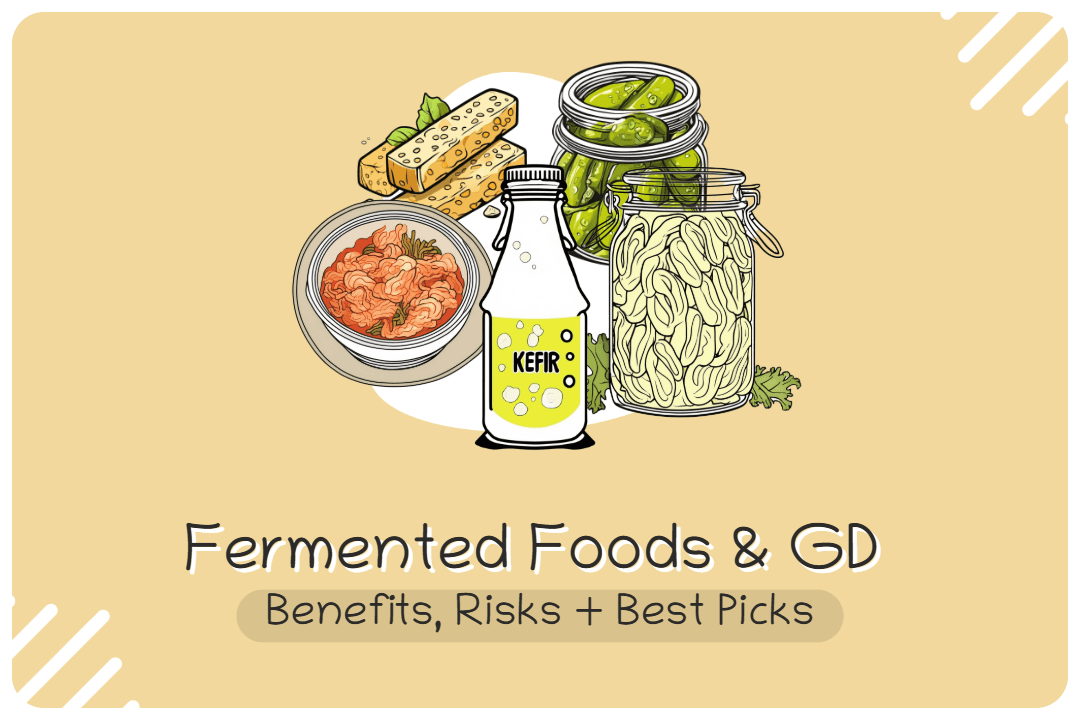
If you’ve been diagnosed with gestational diabetes (GD), you’ve probably seen fermented foods hyped up as a gut-health “hack” that can magically fix blood sugar.
So let’s do a gentle myth-bust, mama-to-mama:
Fermented foods can be a helpful add-on.
They’re not a cure.
And they don’t cancel out placenta hormones.
This post will help you understand what fermented foods are, which ones are most GD-friendly, and how to add them in a way that actually makes sense for real life.
Possibly — for some people. Fermented foods may support overall metabolic health (and digestion) through the gut microbiome, and they can also make meals more balanced and satisfying.
But the effect is usually subtle and individual. If a fermented food is high in sugar (hello, some yogurts and kombuchas), it can still spike you.
Think of fermented foods as a supporting character in your GD plan — not the whole plot.
Fermented foods are foods transformed by beneficial bacteria or yeast. Some contain live cultures (probiotics), and some don’t (depending on how they’re processed).
Common fermented foods you’ll see mentioned in pregnancy/GD:
Yogurt (with live cultures)
Kefir
Sauerkraut
Kimchi
Miso
Tempeh
Kombucha
Pickles (only if they’re fermented — not just vinegar-pickled)
Let’s keep this honest and not overhype it.
When people talk about fermented foods for gestational diabetes mellitus (GDM), they’re usually pointing to scientific evidence around gut health and metabolism.
Some research (including systematic review and review and meta analysis style papers) suggests probiotics and fermented dairy may support markers like glycemic control, glucose control, blood glucose, postprandial glucose, and serum insulin levels in some groups.
If you want to go deeper (data-packed, but readable), here are a few starting points:
Systematic review in American Journal of Obstetrics & Gynecology on probiotics and glycemic control in GDM: https://www.ajog.org/article/S0002-9378(21)01429-0/fulltext
Systematic review/meta-analysis of randomized controlled trials on probiotics and glycaemic control biomarkers: https://www.sciencedirect.com/science/article/pii/S221339842030244X
Overview page on probiotics (plain-language explainer): https://www.nhs.uk/tests-and-treatments/probiotics/
But here’s the gentle myth-bust: a lot of the strongest research is either:
done in healthy pregnant women (not necessarily people with GDM)
focused on probiotic supplementation (capsules) rather than food
or includes mixed results across randomized controlled trials (sometimes even double blind placebo controlled trials)
So yes — there may be a “there” there. But it’s not a magic fix, and it’s not consistent for everyone.
My takeaway: fermented foods can be a supportive add-on for diabetes management in pregnancy — but your results will depend on your personal insulin resistance (hello, placenta), your overall diet, and what your meter says.
It would be amazing if a spoon of sauerkraut could outsmart the placenta… but GD doesn’t work like that.
Gestational diabetes is heavily influenced by pregnancy hormones and pregnancy induced insulin resistance. Fermented foods may be supportive for gut health, but they won’t replace:
Your care team’s plan
Carb targets that work for your body
Medication/insulin if you need it
If fermented foods help you feel better and make meals easier to balance, amazing. If they don’t, you’re not doing anything wrong.
Fermented foods are interesting because they can interact with the gut microbiome (also called the gut microbiota, human gut microbiota, or intestinal microbiota).
In simple terms: your gut is home to beneficial bacteria (and other microbes). Some fermented foods contain live cultures (probiotics), and they may help modulate gut microbiota — meaning they can influence microbiome composition, gut microbiota composition, and gut microbiome composition over time.
Researchers often talk about a few possible pathways:
Certain probiotic strains (specific bacterial strains, like Lactobacillus acidophilus) may support gastrointestinal health and the digestive process
Fermentation can lead to compounds like short chain fatty acids, which are linked in research to metabolism
A healthier gut environment may be associated with lower gut inflammation and a calmer inflammatory response
Some theories involve intestinal permeability (sometimes called “leaky gut” online) and how that might relate to metabolic disorders
The gut may also interact with the immune system
Important note: some of this is based on early data or animal models, and even in humans the effect size can be modest. So I treat this as “interesting + potentially helpful,” not “proven cure.”
If you’re doing "everything" and still seeing stubborn numbers, it’s not because you didn’t eat enough kimchi (or didn't try enough).
Gestational diabetes affects (and is affected by):
insulin sensitivity
insulin secretion and insulin release
serum insulin / serum insulin levels
blood glucose patterns (including postprandial glucose after meals)
overall glucose metabolism and glucose homeostasis
Fermented foods might support overall health, but they won’t override placenta hormones.
The biggest levers are still:
the type and amount of carbs (often complex carbohydrates + dietary fibre work better for many of us)
pairing carbs with protein/fat/fiber
movement, sleep, stress
and medication/insulin if needed (no shame)
If you’re newly diagnosed, remember: the oral glucose tolerance test is a screening/diagnostic tool — it doesn’t predict exactly what your day-to-day numbers will do. Your meter feedback is more personal. And if you're one of the newly diagnosed mamas reading this, then this Guide for Newly Diagnosed includes all the basic and many helpful resource links.
Fermented foods work best as part of a balanced snack or meal.
Examples:
Plain Greek yogurt + berries + nuts
Kefir smoothie with chia + peanut butter
Tempeh added to a veggie stir-fry
Some fermented foods are marketed as “good for your gut” but are still sugar-heavy.
Check labels for:
Total carbs per serving
Added sugar (especially in yogurt and kombucha)
Serving size (because the bottle is often 2 servings)
Pregnancy digestion can be… dramatic.
If you’re new to fermented foods, start with a small amount and see how you feel.
Kimchi, sauerkraut, pickles, miso — delicious, but often salty.
If you’re dealing with swelling, blood pressure concerns, or you’re just feeling puffy, keep portions reasonable and check with your provider if you’re unsure.
For GD, yogurt can be one of the easiest fermented foods to use well — if the label is right.
What usually works best for blood sugar:
Probiotic yogurt / yogurt with live cultures
Plain Greek yogurt or skyr (higher protein)
Lower sugar options
What can be trickier:
Sweetened “conventional yogurt” (often higher carbs)
Flavored drinkable yogurts (easy to accidentally overdo)
If you tolerate dairy, yogurt consumption is one of the simplest ways to add fermented foods without making your meal harder.
Try:
Yogurt + cinnamon + walnuts
Yogurt + berries + chia
Savory yogurt bowl: cucumber + olive oil + salt + herbs
Kefir and other fermented milk drinks can be great — but carbs vary a lot by brand. Some are basically a sweet drink.
Try:
Use as a small smoothie base + add protein/fat (nut butter, chia)
Choose unsweetened when possible
Sauerkraut is a classic example of fermented vegetables. It’s great as a “sidekick” to add crunch and flavor.
Try:
Add to eggs
Add to a salad bowl
Add to a sandwich/wrap on a lower-carb base (if that works for you)
Same idea as sauerkraut — plus it can add a lot of flavor when food feels boring.
Try:
Kimchi + eggs
Kimchi on a bowl with protein + veggies
Miso and tempeh come from fermented soybeans. They can be a nice option because they add flavor and protein without needing a big carb base.
A little goes a long way.
Try:
Miso soup with tofu + seaweed
Miso glaze on salmon or tofu
A fermented soy product that’s usually higher protein.
Try:
Tempeh strips + roasted veggies
Tempeh added to curry (watch rice portions)
Pickles can be confusing:
Vinegar-pickled = not fermented (still fine, just different)
Fermented pickles = usually in the refrigerated section and labeled “fermented” or “naturally fermented”
Either way, they can be a crunchy, low-carb add-on — just watch sodium.
Kombucha often contains sugar (even if it’s “fermented”), and some people spike from it.
But in pregnancy, kombucha can also be a little controversial because it’s fermented (so alcohol traces can vary), it may contain caffeine, and some products are unpasteurized.
If you want to try it:
Keep portions small
Drink it with food (not on an empty stomach)
Check carbs and added sugar
And always follow pregnancy safety guidance from your provider (some people prefer to avoid kombucha in pregnancy).
Plain Greek yogurt + nuts
Yogurt + berries
Kefir smoothie (small) + chia + peanut butter
Miso soup packet + tofu (at home/work)
Eggs + sauerkraut/kimchi on the side
Tuna + sauerkraut on cucumber rounds
Greek yogurt + cocoa powder + peanut butter (dessert-ish vibes)
Skyr + a few raspberries + chopped almonds
If fermented foods feel good in your body and fit your culture/food preferences, they can be a really lovely addition during gestational diabetes — not because they’re “magic,” but because they can add flavor, variety, and a little gut-supportive goodness to meals that can start to feel repetitive fast.
But I also want to say this clearly: you don’t need to “optimize” your gut to manage GD. If you’re doing your best and your numbers are still stubborn sometimes, that’s not a personal failure — that’s pregnancy hormones doing what pregnancy hormones do. Fermented foods might help a little for some people, but they won’t override placenta-driven insulin resistance, and they’re not a replacement for the basics that actually move the needle.
What you do need is food that’s realistic and sustainable: meals and snacks you can repeat on tired days, options that keep you full, and simple combos that work for your numbers (most of the time). If kimchi makes you feel bloated, you don’t have to force it. And if you love miso soup and it helps you enjoy dinner again? That matters too.
So use fermented foods as a supportive tool in your toolbox — experiment gently, keep an eye on labels (especially sugar and portion sizes), and let your meter + your care team guide you. And most importantly: you’re not behind, you’re not doing it wrong, and you don’t need to be perfect to be doing a great job.
1. Can fermented foods lower blood sugar?
They may support overall metabolic health for some people, but they’re not a guaranteed way to lower blood sugar — and they won’t override placenta hormones. If you try them, let your meter (and your care team) guide you.
2. Can fermented foods improve insulin sensitivity in gestational diabetes?
They might support insulin sensitivity indirectly through gut health and overall diet quality, but results vary. In pregnancy, insulin resistance is strongly hormone-driven, so fermented foods are best seen as a supportive habit — not a treatment.
3. Do probiotics help gestational diabetes mellitus (GDM)?
Some research (including systematic review and meta papers and randomized controlled trials) suggests probiotics may influence glucose control, serum insulin, and glycemic control in certain groups. But supplements aren’t the same as food — so check with your provider before starting probiotic supplements.
4. Are probiotics safe in pregnancy?
Many people use probiotic foods in pregnancy, but supplements are different. If you’re considering probiotic supplements, check with your provider.
5. Are fermented foods safe in pregnancy?
Many fermented foods are commonly eaten in pregnancy, but safety can depend on the product and how it’s made (and your personal health situation). When in doubt, check with your provider.
6. Why do some fermented foods spike my blood sugar?
Because fermentation doesn’t erase carbs. Sweetened yogurt, some kefirs, and kombucha can contain enough carbs/sugar to raise blood glucose and postprandial glucose, even if they’re “good for your gut.”
7. What if fermented foods make me bloated?
Totally normal. Start small, try a different type (yogurt often feels gentler than kimchi), and don’t force it.
8. Is kombucha okay with gestational diabetes?
It depends. Kombucha can be higher sugar than it looks, and some people spike from it. If you try it, keep the portion small, drink it with food, and check the label. Kombucha can also be a little controversial because it may contain caffeine, and some products are unpasteurized.
9. Can fermented foods reduce inflammation?
Some theories connect the gut microbiome, immune system, and inflammatory response. Fermented foods may support a healthier gut environment for some people, but it’s not guaranteed — and it’s not a quick fix.
10. What are the biggest risk factors for gestational diabetes?
Common risk factors include higher prepregnancy body mass index (BMI), family history, prior GDM, certain metabolic disorders, and more — but plenty of people with “no risk factors” still get it. It’s not your fault.
Disclaimer: This post is for education and support and isn’t medical advice. Always follow your care team’s guidance.
Get a Free 20-Day Shopping List