

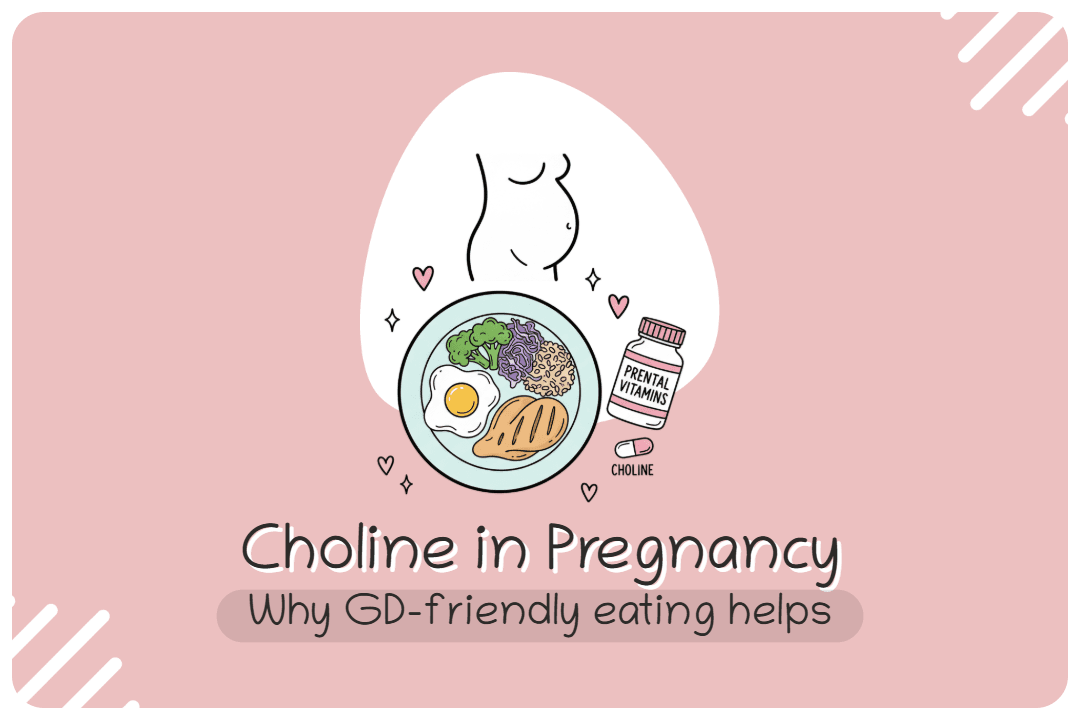
When you get diagnosed with gestational diabetes (GD), it can feel like your whole pregnancy suddenly becomes about blood sugar: carbs, meal timing, and “what can I eat without spiking?”
But here’s a little “bonus nutrient” moment, mama: the same food pattern that often supports steadier glucose—more protein, fewer ultra-processed foods, more balanced meals—can also make it easier to receive adequate choline.
Choline is an essential nutrient in pregnancy. It supports fetal brain development, the nervous system (including the spinal cord), cell membranes, and epigenetic regulation (DNA methylation and gene regulation). And yet, many pregnant women don’t get the recommended amount.
This post ties together choline in pregnancy + choline intake + prenatal vitamins + choline rich foods—with a GD-friendly lens.
Choline is an essential nutrient that supports fetal development, especially fetal brain and nervous system development.
Many guidelines recommend 450 mg/day of choline during pregnancy (and 550 mg/day during lactation).
Most prenatal vitamins contain little to no choline, so food (and sometimes dietary supplements) matter.
A gestational diabetes-friendly diet often includes more choline-rich foods (eggs, meat, fish, dairy products, soy) without you even trying.
Research on maternal choline supplementation is promising (attention/information processing outcomes in some studies), but it’s not a guarantee.
If you’re considering choline supplements (like choline bitartrate), talk with your provider—especially if you have liver dysfunction, mental health concerns, or other risk factors.
Choline is a nutrient your body uses for several critical jobs:
Building cell membranes (phospholipids)
Choline metabolism and lipid transport (important for maternal liver function)
Neurotransmitter production (acetylcholine)
Epigenetic regulation (DNA methylation / gene regulation)
In pregnancy, these roles matter even more because you’re supporting both the mother and the fetus during a critical period of rapid growth.
Choline plays a role in fetal brain development and nervous system development, including the formation of neural connections. This is why you’ll often see choline discussed alongside other pregnancy nutrients like folate/folic acid.
Julija notes: We hear “folic acid” constantly in pregnancy. Choline is like the quieter cousin that still deserves a seat at the table.
Many recommendations cite 450 mg/day as the recommended choline intake for pregnant women (and 550 mg/day during lactation). These values are often referenced from major guideline bodies (e.g., National Academy recommendations).
A big reason this matters: only a small percentage of pregnant women meet the adequate choline intake through diet alone.
Sometimes—but often, no.
Most prenatal vitamins contain little to no choline (or not the same amount that would meaningfully close the gap). That’s why food sources—and occasionally choline supplementation—come up in pregnancy nutrition conversations.
A GD-friendly eating pattern typically emphasizes:
protein at meals and snacks
fiber-rich foods
fewer refined carbs
balanced plates
And many of those staples are naturally high in choline content.
Here are common choline-rich foods that often fit well in a gestational diabetes meal pattern:
Egg yolks / eggs (one large egg contains about 147 mg of choline)
Beef liver (about 356 mg per 3 oz—very high; ask your provider about liver in pregnancy due to vitamin A)
Chicken breast (about 72 mg per 3 oz)
Fish (including salmon)
Dairy products (cow’s milk contributes about 43 mg of choline per cup)
Soybeans (about 107 mg of choline per 1/2 cup)
Cruciferous vegetables and whole grains (not as high as eggs/meat, but they add up)
You’ll also see choline listed as free choline on some nutrition labels or research summaries—that’s just one way choline appears in foods.
Choline isn’t a treatment for gestational diabetes.
But if you’re already building meals around eggs, meat, fish, dairy, soy, and non-starchy vegetables (plus a tolerated carb portion like whole grains), you may be increasing choline intake as a side effect of eating in a way that supports steadier blood sugar.
There’s growing research on maternal choline supplementation and pregnancy outcomes. Some studies suggest that higher choline intake during pregnancy may support child attention and information-processing outcomes.
One randomized study often discussed found improved sustained attention at age 7 when expectant mothers consumed around 930 mg/day during pregnancy.
Important context:
This is promising research, not a guarantee.
Results can vary due to genetic factors, baseline diet, and other nutrients.
It doesn’t mean everyone needs extra choline or supplements.
You’ll sometimes see claims that choline supplementation reduces the risk of neural tube defects (neural tube / spinal cord development). The most established nutrient for neural tube defects is folate/folic acid, but choline also plays roles in methylation and early development.
Because the evidence and wording here can get messy fast, the safest framing is:
Folate is the cornerstone for neural tube defect prevention.
Choline supports early fetal development and methylation, and researchers are exploring how adequate choline intake may matter alongside folate.
Choline is also discussed in research contexts like:
maternal liver dysfunction / fatty liver (choline supports liver lipid metabolism)
mental health (emerging research; not definitive)
fetal alcohol exposure (research explores whether extra choline may influence outcomes, but alcohol consumption in pregnancy is still a clear avoid)
possible links with gestational complications (research is ongoing)
Food-first is a great starting point.
If you’re considering choline supplements or dietary supplements, here are the practical things to know:
Common supplement form: choline bitartrate (there are various forms)
Check your prenatal vitamin label (many contain little to no choline)
Talk to your provider about your diet, risk factors, and whether you’re likely to receive adequate choline
More isn’t always better.
The tolerable upper intake level (UL) for pregnant adults is often cited as 3,500 mg/day. Most people won’t get anywhere near this from food, but it’s still a reason to avoid mega-dosing without medical guidance.
If you want to be more intentional—without turning food into another pregnancy job—try:
Add 1–2 eggs at breakfast (or as a snack)
Build lunches around chicken/turkey + veggies + a tolerated carb portion
Rotate in fish you tolerate (and your provider okays)
Use Greek yogurt / cottage cheese as a protein base
Add soy options like tofu or edamame
Keep movement gentle: physical activity (like a short walk) can support GD management too
A GD-friendly eating pattern is about supporting steadier blood sugar—but it can also make it easier to get closer to adequate choline intake in pregnancy.
Choline is an essential nutrient involved in fetal brain development, nervous system development, cell membranes, and methylation. And while research on extra choline and long-term child outcomes offers valuable insights, the most practical takeaway is simple:
Focus on a balanced, protein-forward pattern you can actually stick with—and you may be supporting both glucose and key pregnancy nutrients at the same time.
1. What is choline and why is it important in pregnancy?
Choline is an essential nutrient that supports fetal brain and nervous system development, cell membranes, and methylation. Many pregnant women don’t get enough from food alone, which is why it’s getting more attention in pregnancy nutrition.
2. How much choline do pregnant women need?
Many guidelines recommend about 450 mg per day during pregnancy. Your needs can vary based on your diet and prenatal vitamin, so it’s worth checking what you’re currently getting.
3. Is choline especially important for the baby’s brain?
Yes—choline plays a role in fetal brain development and early nervous system growth. It’s one of the key nutrients involved in building and supporting rapidly developing tissues.
4. Are eggs a good source of choline in pregnancy?
Yes. Eggs are one of the most choline-rich foods, and they’re also a common GD-friendly option because they’re protein-forward and easy to pair with fiber and healthy fats.
5. What are the best choline-rich foods for gestational diabetes?
Many GD-friendly staples are also good choline sources, including eggs, chicken, turkey, salmon/fish, dairy (Greek yogurt, cottage cheese), and soy foods (tofu, edamame). Pair them with non-starchy veggies and a tolerated carb portion for steadier blood sugar.
6. Does a gestational diabetes diet help you get more choline?
Often, yes—without you even trying. GD-friendly eating tends to include more protein-rich, minimally processed foods, and many of those foods naturally contain more choline.
7. Do prenatal vitamins contain choline?
Some do, but many contain little or none. If choline is a focus for you, check your prenatal label and ask your provider whether you should aim to get more through food or consider a supplement.
8. Should I take a choline supplement during pregnancy (especially with GD)?
Food-first is a great starting point, but supplements are a personal decision. If you’re considering choline supplements during pregnancy, it’s best to talk with your provider—especially if you’re managing GD and already taking other prenatal supplements.
HIgedi is a support and education community, not medical advice. Always talk to your healthcare provider (OB/midwife, dietitian, endocrinologist) before making changes to supplements or your pregnancy care plan.
Get a Free 20-Day Shopping List